Repeated rental frequency by jobsite: when a class is worth buying
By RentalSpend ·
Repeated rentals at the same jobsite are a useful signal, but not enough by themselves. Use them to screen for ownership, then confirm utilization, downtime, and full ownership cost before you buy.
On this page
- Illustrative example: a skid steer class that keeps reappearing at the same jobsites
- Step 1: group rentals by class and jobsite
- Step 2: convert frequency into a usage signal
- Step 3: compare frequency with utilization and full ownership cost
- Step 4: decide whether the pattern is core, seasonal, or one-off
- Step 5: what to do when the numbers do not line up
- How to apply the same check to your own invoices
- Common questions
Use repeated rental frequency by jobsite as a screen for ownership, not as the final buy decision. If the same equipment class keeps showing up at the same site or for the same crew, that class may be recurring often enough to own, but you should still confirm it has enough utilization, fits your work pattern, and costs less to own than to keep renting once maintenance, storage, financing, warranty, and downtime are included.[1][2][3][4][5][6]
Illustrative example: a skid steer class that keeps reappearing at the same jobsites
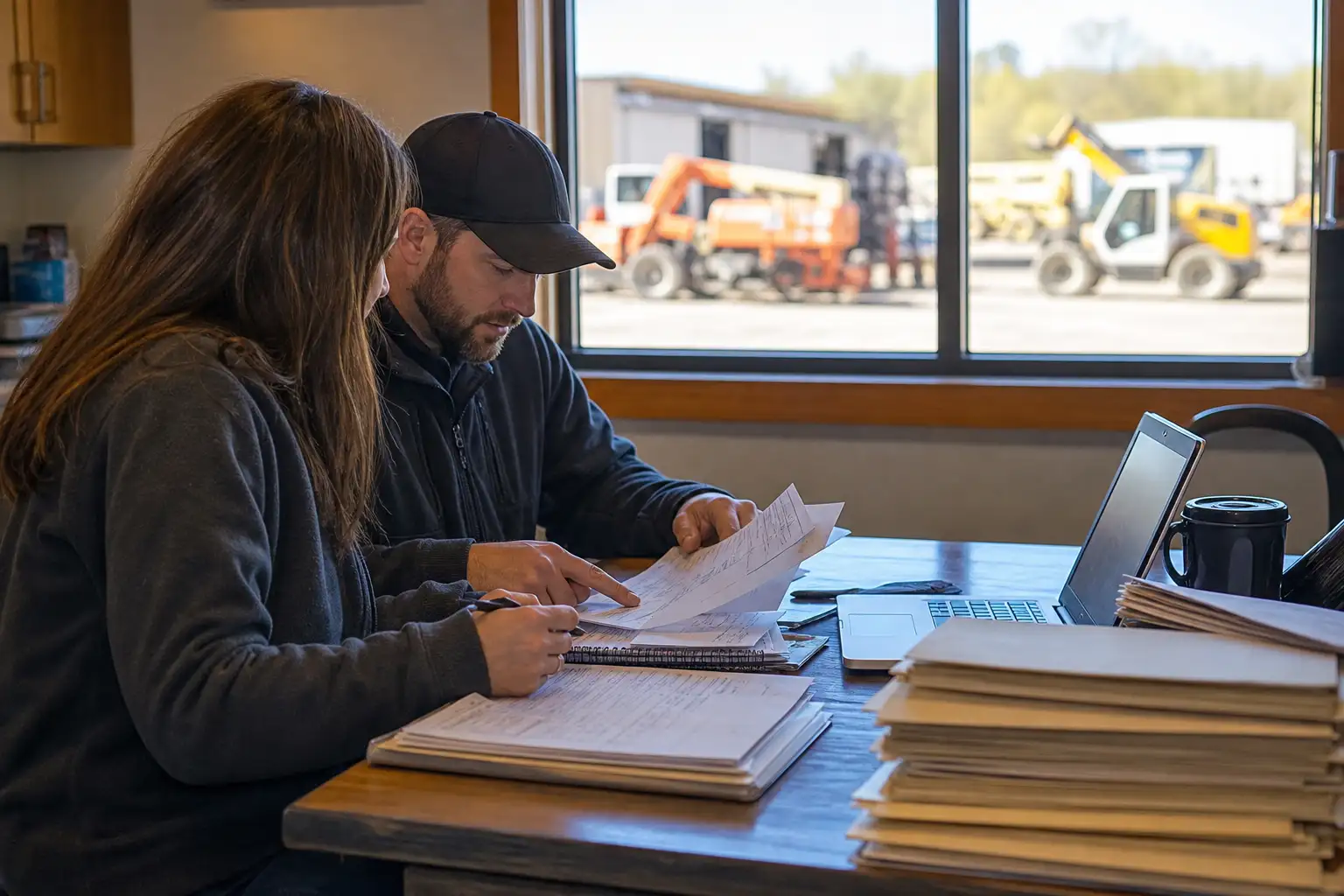
Suppose your AP team and equipment manager review six months of rentals and find the same skid steer class on three jobsites. The class appears repeatedly, but you still need to separate frequent use from a true ownership case. The useful question is not only how many times it was rented, but whether the pattern points to steady use, enough annual hours, and a lower total cost if you own one unit.[3][4][7]
In this hypothetical, the records show 9 rentals over six months, with each rental averaging 12 days. That gives you 108 rental days in six months. If the pattern continues, the annualized usage is 216 rental days. That is a strong signal that the class is not occasional. It still does not prove you should buy, but it does justify a full ownership review.[3][4][7]
Step 1: group rentals by class and jobsite
Start with rental history from invoices, rental agreements, off-rent confirmations, pickup records, and accounting data. Group the records by equipment class first, then by jobsite, crew, and month. That lets you see whether a class is truly recurring at the same place or just appearing randomly across many short jobs. Tracking at the individual class level matters because fleet totals can hide the pattern you need for a buy decision.[3][4]
- Pull a defined period of history, such as the last 12 months or a full project cycle if your work is seasonal.
- Sort rentals by equipment class, then by jobsite, crew, and month.
- Count how many times each class appears at each jobsite and how long each rental stayed out.
- Note whether the same class was re-rented after pickup, which can signal a recurring gap rather than a one-time need.
- Separate core production equipment from specialty attachments, emergency backups, and seasonal tools.
Step 2: convert frequency into a usage signal
Once you can see repeated rentals by jobsite, turn them into a simple usage measure. Count rental days, not just rental tickets, because two short tickets can matter less than one long one. If the class is showing up often and staying out for meaningful periods, the case for ownership gets stronger. If the class is rented often but only for short bursts, you may still be better off renting because demand may be spiky or tied to specific phases of work.[2][3][5]
- High frequency plus long duration usually supports ownership review.
- High frequency plus short duration may still favor renting if the work is intermittent or seasonal.
- Low frequency, even with one long project, may still favor renting if the need is occasional.
- If the class is needed at several sites at once, check maximum simultaneous demand before you buy only one unit.
Step 3: compare frequency with utilization and full ownership cost
Frequency by jobsite is only a screen. The actual buy decision depends on utilization and total cost. A common rule of thumb from Caterpillar is that below 40% utilization, renting is often better; between 40% and 65%, the answer depends on other factors; above 65%, buying may make sense. That is guidance, not a universal rule. You still need to include maintenance, storage, financing, warranty coverage, insurance, and cash flow, because the cheapest rental pattern on paper can become expensive once ownership costs are added.[1][6][5]
| Check | What to measure | Why it matters |
|---|---|---|
| Repeated rentals by jobsite | Count rental tickets and rental days by site, crew, and class | Shows whether the need is recurring or just occasional |
| Utilization | Estimate annual days or hours in use | Helps separate core fleet from low-use equipment |
| Total ownership cost | Purchase price, maintenance, storage, financing, insurance, and downtime | Shows the real cost of owning |
| Operational fit | How often the class is needed at more than one site at once | Prevents buying too few units |
| Seasonality | Whether demand is concentrated in one season or project phase | Helps avoid owning idle equipment |
Step 4: decide whether the pattern is core, seasonal, or one-off
A class that appears often at the same jobsite may still belong in the rental bucket if it is tied to a specific season, a special project type, or a narrow geographic need. A class used day after day as part of normal production is a stronger ownership candidate. In other words, repeated rentals are a signal of recurring demand, but the business question is whether that demand is stable enough to support ownership.[1][2][4][5]
- Core fleet: used regularly, across most of the year, and easy to keep utilized.
- Seasonal need: repeated every year, but only during a narrow window; ownership may work only if idle time is acceptable.
- One-off or special project need: the class appears repeatedly in your records but only because one job was unusually large or complex; renting is often still better.
- Shared fleet need: the class is needed often, but not often enough in any one place to justify multiple owned units.
Step 5: what to do when the numbers do not line up
If repeated rental frequency suggests ownership but utilization is still low, look for the reason. The class may be rented often because you are moving it between sites inefficiently, because dispatch is slow, or because crews are re-renting instead of requesting a transfer from another location. If the class looks economical to own but the jobsites are far apart or demand is uneven, the right answer may be one owned unit plus rentals for overflow, not a full buyout.[3][4][5]
- Confirm whether repeated rentals are caused by a true production need or by poor internal equipment allocation.
- Check whether one owned unit could replace several short rentals if you improved dispatch or transfer timing.
- Review pickup records, off-rent timing, and credit memos for delays that inflate rental days.
- If the class is seasonal, test the decision on the busiest months, not the quiet months.
- If demand exceeds one unit but not two, consider owning one and renting the overflow.
How to apply the same check to your own invoices
Use the same method on your own records by pulling a year of rentals for one class at a time. Count how often the class appears at each jobsite, estimate annual days or hours, and compare that pattern with your ownership cost. If the class is repeatedly rented at the same sites and the utilization is high enough that the owned unit would stay busy, it moves onto the buy list. If the pattern is erratic, seasonal, or tied to short jobs, keep renting and focus on better dispatch, better rate control, or better off-rent discipline instead.[1][3][4][5][6]
Practical next steps: pick one high-spend equipment class, map the last 12 months of rentals by jobsite, calculate annualized rental days, and compare that against your own ownership cost and utilization target before deciding whether that class belongs in the owned fleet.[1][3][5][6]
Common questions
Should I use 90 days or 12 months to measure repeated rental frequency?
Use the period that best matches your work. Twelve months is usually safer for seasonal businesses, while a full project cycle can be better if demand is tied to one job.
Does a high number of rental tickets automatically mean I should buy?
No. A high ticket count can still favor renting if the equipment is used briefly, seasonally, or only on one type of project.
What records are most useful for this analysis?
Invoices, rental agreements, off-rent confirmations, pickup records, credit memos, and internal jobsite or equipment logs are the most useful starting points.
How should I handle a class that is repeated at one site but not elsewhere?
Check whether that site has a long-running, stable need or just an unusually large project. If the need is site-specific and temporary, renting may still be the better choice.
What if the class is needed often but only in small bursts?
Short bursts often point to renting, unless those bursts are so frequent that the ownership cost is clearly lower than the repeated rental cost.
Should I buy more units if the same class appears at several jobsites at once?
Possibly, but first compare maximum simultaneous demand with your current fleet so you do not buy more capacity than you can keep utilized.
RentalSpend checks equipment-rental invoices against your agreed rates. Start a free invoice audit to see what to review on your own invoices.
Start a free invoice auditRelated guides
- Which equipment classes are overpriced before rate negotiation
- How to spot rental lines that deserve a buy-versus-rent review
- Which equipment classes to review for buy-versus-rent decisions
- Keeping Equipment-Rental Rate Sheets Current by Branch and Class Code
- Build a rent-vs-buy review list from invoices and PO history
Sources
- Rent, Lease or Buy Equipment? · Caterpillar
- Buying Versus Renting Construction Equipment · Caterpillar
- Renting Equipment and How It Keeps You Versatile and Competitive · Cat Rentals
- Utilization 101 · For Construction Pros
- 'Right-Sizing' Your Generator Fleet · For Construction Pros
- Buy or Rent? Making the Right Choice for Your Next Air Compressor · For Construction Pros
- How to Determine Whether to Buy, Rent or Lease Compact Excavators · For Construction Pros
This guide is general information, not legal or accounting advice. Rental terms differ by agreement and supplier; check your own contract and rate sheet.